
Every Missed Call at Service Is a Table You Just Gave Away
Every call that rings out during service is a booking, a big order or a private-dining enquiry walking to the restaurant down the road. Here is what an AI receptionist for restaurants actually handles, and where the line sits.

Buyer Psychology & AI Distribution Strategist
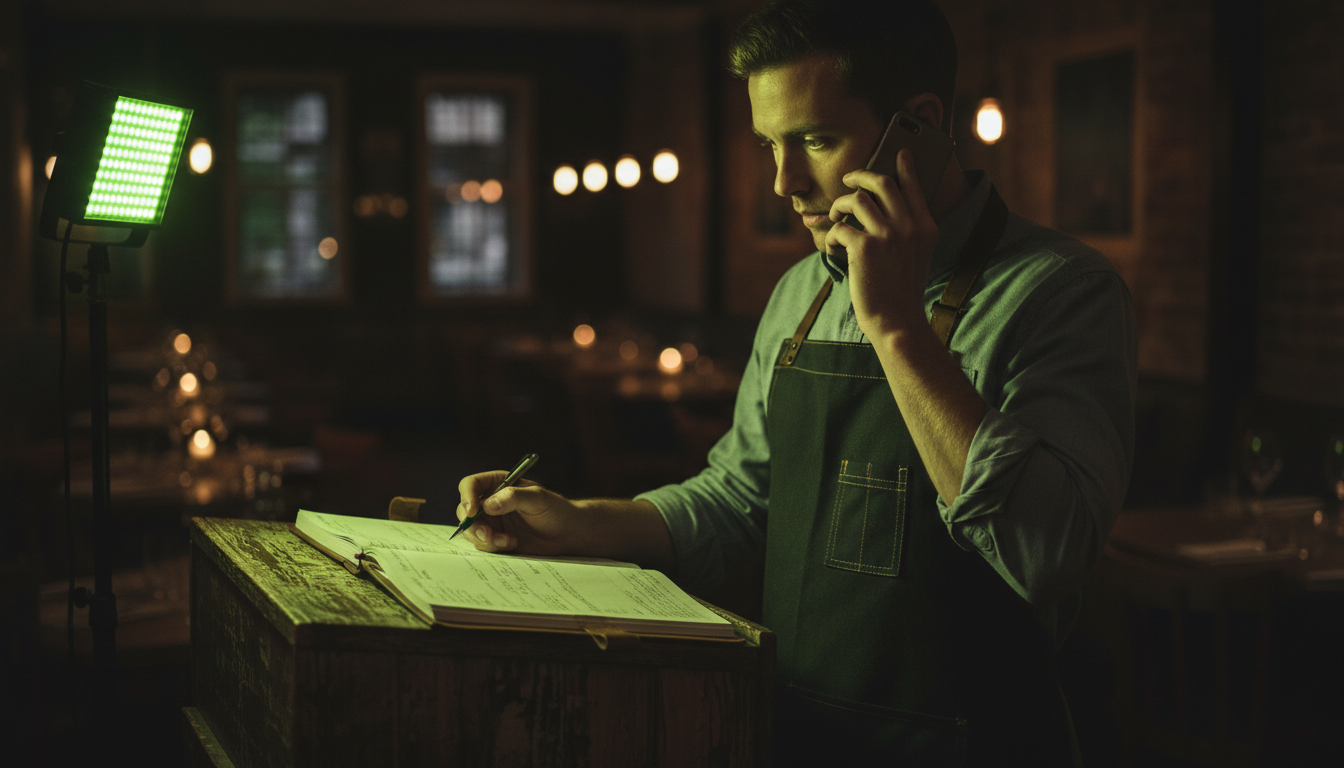
The phone rings at 7:40pm on a Friday. Your host is running three plates to table nine, the pass is calling, and nobody can get to it. It rings out. That caller wanted a table for six. They do not leave a voicemail. They ring the place down the road, and that place picks up.
That is the quiet leak in most owner-run restaurants. Not the bad reviews, not the no-shows you already track. The calls nobody answered during the exact hours you were too busy to answer them. An AI receptionist for restaurants exists to close that gap, but only if you understand what it should do on its own and where it must hand over to a human.
What a missed call actually costs you
The maths is not abstract. Restaurants miss a large share of inbound calls during peak service, and peak service is precisely when the highest-value calls come in: bookings for tonight, large parties, catering enquiries. Every one that rings out is not a lost call, it is a lost cover.
Run your own numbers. If your average spend per head is 35 pounds and a missed Friday call was a table of four, that single unanswered ring is 140 pounds that walked. Miss three a night across a week and you are looking at real money, week after week, with no line item to show for it. The loss never appears on a report because the sale was never made. That is what makes it so easy to ignore and so expensive to keep ignoring.
This is the same pattern across every owner-operated business, which is why we built an agentic AI system that answers the first message before it goes cold. For restaurants, the first message is almost always a phone call during your busiest ninety minutes.
What an AI receptionist for restaurants should handle on its own
An AI receptionist answers every call, on the first ring, in your restaurant's voice, at any hour. The jobs it should own without ever waking you:
- Reservations. It takes the party size, date, time and name, checks live availability against your booking system, and confirms the table. No third-party call, no callback.
- Menu and logistics questions. Opening hours, where to park, whether you do corkage, if the kitchen is still open, what is on tonight. The repetitive questions that eat your host's attention get answered instantly.
- Simple takeaway and collection orders. It reads back the order, sends a payment link or ordering link, and confirms the pickup time.
- Overflow during service. When your host is buried, it does not replace them. It catches the calls they physically cannot reach, so the choice stops being "answer the phone or run the floor".
Done well, that alone recovers most of the revenue currently ringing out. It replies in under sixty seconds because it never puts anyone on hold.
Where the line sits: allergens and private dining
This is the part the vendor pages skip, and it is the part that matters most in a restaurant.
Allergens are not a normal question. A wrong answer about a menu question is unhelpful. A wrong answer about a nut, shellfish or gluten allergy is dangerous, and in the UK it carries legal weight under Natasha's Law and food-safety regulation. An AI receptionist should never freelance an allergen answer from a menu it half-understands. The correct behaviour is a hard rule: acknowledge the allergy, never guess, and route the caller straight to a human who can check the kitchen. Escalation here is not a failure of the system, it is the system working as designed.
Private dining and large parties deserve a human too. A table of two is a booking. A party of twenty, a set menu, a private room or a Christmas function is a negotiation: deposits, dietary spreads, pre-orders, room hire. That is high-value revenue you do not want auto-confirmed by a bot. The receptionist should capture the enquiry (date, party size, budget, contact) the moment it lands, then hand a warm, complete lead to you rather than letting it sit in a voicemail until Monday.
The rule of thumb: let it auto-handle the high-volume, low-risk work, and escalate anything where a wrong answer is unsafe or a booking is too valuable to automate. You set those thresholds. It respects them.
Booking-system integration is the whole game
An AI receptionist that cannot see your live table availability is just a nicer answering machine. The value only appears when it reads and writes to the system you already run, whether that is OpenTable, a Square-based setup or your own diary. Before you trust any tool, ask one question: does it check real availability and write the booking back, or does it just take a message? If it only takes a message, you have not solved the missed-call problem, you have delayed it.
The same discipline applies to your POS and ordering flow. Collection orders should land where your kitchen already sees them, not in a separate inbox nobody watches mid-service.
The point is the covers you stop losing
You did not open a restaurant to answer the phone. You opened it to run a floor and cook. Right now the phone forces you to choose between the two every Friday night, and the calls you drop are the ones worth the most. An AI receptionist for restaurants gives you a first responder that never chooses wrong on the easy calls and always escalates the ones that matter.
See how it handles your restaurant's real calls, including the awkward allergen and big-party ones, before you commit to anything. Take the free Front Desk test drive and watch it answer, in your voice, the calls you are losing tonight. If you want the restaurant-specific breakdown first, the Front Desk for restaurants page walks through exactly what it books and what it escalates.
Tags
FREE SOLOPRENEUR PLAYBOOKS
Escape the 'Build & Pray' trap today.
Get the free 0-Dollar Distribution Checklist and the Eugene Schwartz ICP Discovery Matrix Google Sheets. 100% free, zero friction.
Explore Free Playbooks & Templates →