
You're Losing Jobs While Gloved Up: AI Answering for Electricians
An answering service that only takes messages is a voicemail with better manners. Here is what an AI answering service for electricians should book, and the two things it must never touch.

Buyer Psychology & AI Distribution Strategist
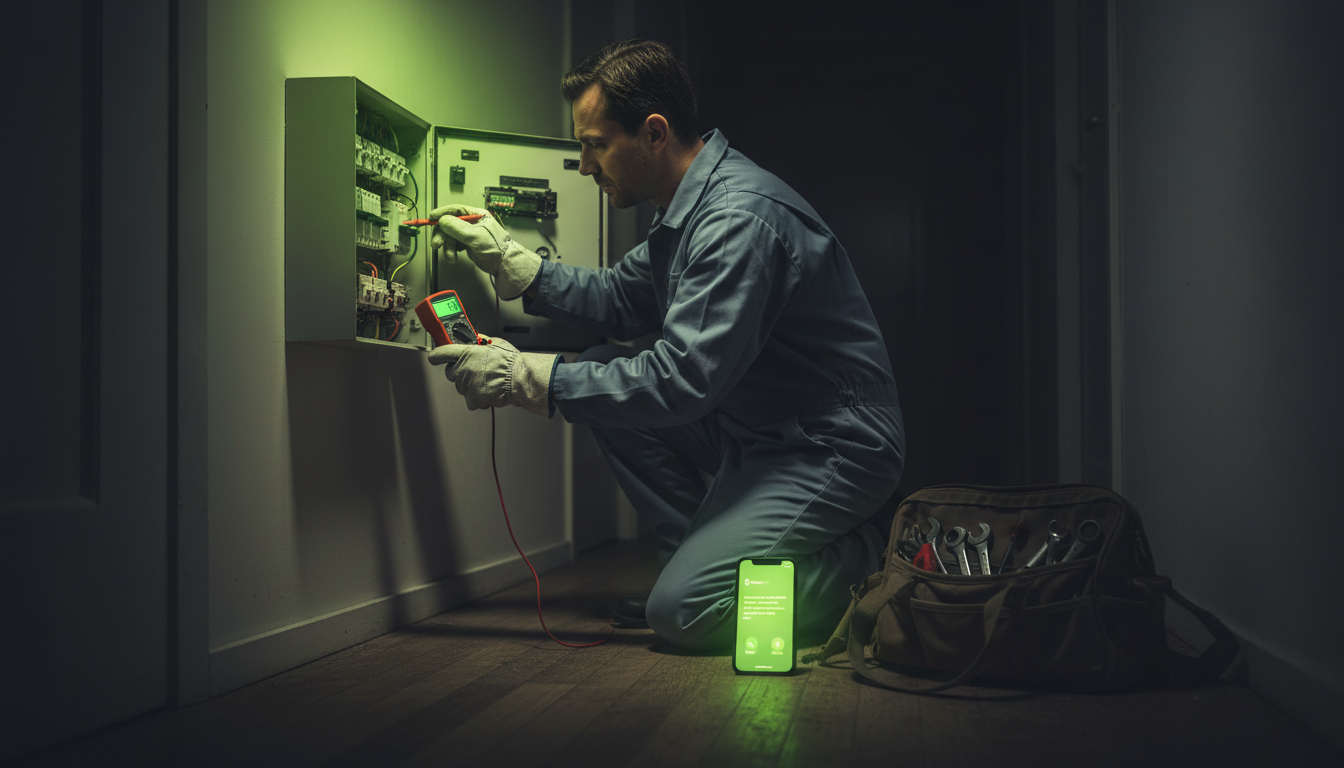
Three rings and a voicemail beep is how a rewire goes to the sparky down the road. The customer with half a house in the dark is not leaving a message and waiting for a call back. They are working down the search results until a human voice picks up. You were up a ladder with the board isolated, which is exactly where you should have been. The job still went to whoever answered second, and it was not you.
The call you miss is not lost, it is given away
Missed calls do not sit in a queue waiting for you to get to them. They get reassigned, in real time, by the customer. Every enquiry that hits your voicemail is a live lead handed to the next name on the list, usually within a few minutes.
The painful part is what those calls are worth. A no-power callout is a couple of hundred pounds. An EICR on a three-bed rental leads to remedial work. A fuse board upgrade, a garden office supply, a full rewire: these are four-figure jobs that arrive through the same phone number as the "my socket is buzzing" calls. You cannot tell which is which until someone answers, and you are not going to answer while your hands are inside a consumer unit.
This is the exact gap agentic AI systems were built for: not a bot that reads a script, but software that reads the enquiry, replies in your voice, and does the next step inside limits you set. The same pattern applies across the trades, which is why we mapped it first for plumbers.
You do not miss calls after hours, you miss them at 11am
Every vendor page selling an AI answering service for electricians leads with 24/7 cover. Out-of-hours matters, but it is not where most of your loss happens.
You miss calls in the working day. Gloves on. Loft insulation everywhere. Isolated board, torch in your teeth, phone in the van. Driving between jobs on the A2. Under a floor. On a site where your phone has no signal and you get seven missed calls in a lump at 2pm.
An overnight answering service does nothing for any of that. What you need is something that picks up in seconds every single time, including the fifteen minutes you spent making good a chase in a plastered wall. Speed of first response is the whole game. The first credible reply usually wins the job, and "credible" means it answered the actual question, not "we have received your enquiry".
The two things an AI must never handle on your phone
Here is the bit no vendor page will tell you, because they are all selling the same box.
One: a live safety risk. Burning smell. Smoke from a socket. Sparking at the board. Water near a consumer unit. Exposed conductors where a child can reach them. An AI that confidently talks a homeowner through any of that is a liability with a phone number. The correct behaviour is narrow and boring: recognise the language, tell the caller to isolate at the main switch if it is safe to do so, tell them to call the emergency number for their distribution network operator if there is smoke or a burning smell, and get a human on the line immediately. No advice, no diagnosis, no reassurance it cannot back up. Electrical Safety First is the reference for what a member of the public should actually be told, and it is not a chatbot's job to improvise around it.
Two: a firm price. Quoting blind on an electrical job is how you end up doing a rewire at a socket-change price. Cable runs, access, plaster, board age, earthing arrangement, whether the last person to touch it knew what they were doing: none of that is knowable from a phone call. An AI can give a call-out fee, an hourly rate, a typical range with the word "typical" in it, and a booked survey slot. It should never give a number you are then contractually arguing about on the doorstep.
Everything else is fair game.
What good actually looks like: triage, book, escalate
Strip out the marketing and a useful answering setup for a sparky does four things.
It answers in under a minute, every time. Phone, web form, WhatsApp, Facebook, the lot. In your voice, using your words, not a call centre script.
It triages. Three buckets. Emergency (no power, burning smell, sparks, water ingress) goes straight to you with the address and the symptom, phrased so you can decide in five seconds. Routine (extra sockets, light fittings, EV charger enquiry, EICR, landlord certificate, fault find) gets qualified and booked. Quote enquiry (rewire, board upgrade, new circuit, extension first fix) gets a survey slot in the diary, because the survey is the sale.
It captures what you would have asked. Property age. Board type and whether it has RCD protection. Owner or tenant or landlord or agent. Parking and access. Whether the power is off right now. Whether anyone is vulnerable in the property. That is a job sheet, not a message.
It escalates on rules you set. You define the thresholds: what it can book, how far ahead, what it must never say, what pings your phone instantly. That is bounded autonomy, and it is the difference between a tool you trust on a Tuesday and one you switch off by Friday.
The UK bits an American answering service will get wrong
Most of the tools on the first page of Google were built for US contractors. It shows the moment a real enquiry lands.
A UK caller says "I need an EICR for my rental, the agent says it has expired". Under the Electrical Safety Standards in the Private Rented Sector (England) Regulations 2020, that landlord has a legal deadline and a report to hand over. That is a hot lead with a date on it, and a bot that treats it as a generic "inspection request" wastes it.
Same with Part P notifiable work, NICEIC or NAPIT registration questions, consumer unit terminology (it is not a breaker panel), and callers asking whether you can self-certify. Your answering layer has to speak the language your customers speak, or it flags you as an outsider before you have said a word.
And on cost: some vendors compare their annual fee against a full-time receptionist salary. Treat that as their claim, not a benchmark. The number that matters to you is simpler. How many jobs a month did you lose because nobody picked up, and what were they worth.
See what it does with your next missed call
The Front Desk is a free test. You give it your business, it answers a real enquiry the way you would, triages it, books what it should book, and escalates what it must never touch. You read the reply before you decide anything. Run it on your own number and see what has been slipping through.
Tags
FREE SOLOPRENEUR PLAYBOOKS
Escape the 'Build & Pray' trap today.
Get the free 0-Dollar Distribution Checklist and the Eugene Schwartz ICP Discovery Matrix Google Sheets. 100% free, zero friction.
Explore Free Playbooks & Templates →