
Your Product Doesn't Sound Like AI. It Sounds Like Nobody.
Everyone is hunting for the prompt that makes AI writing sound human. That's the wrong hunt. The real reason a guide reads flat has nothing to do with the words, and fixing it changes what you build.

Buyer Psychology & AI Distribution Strategist
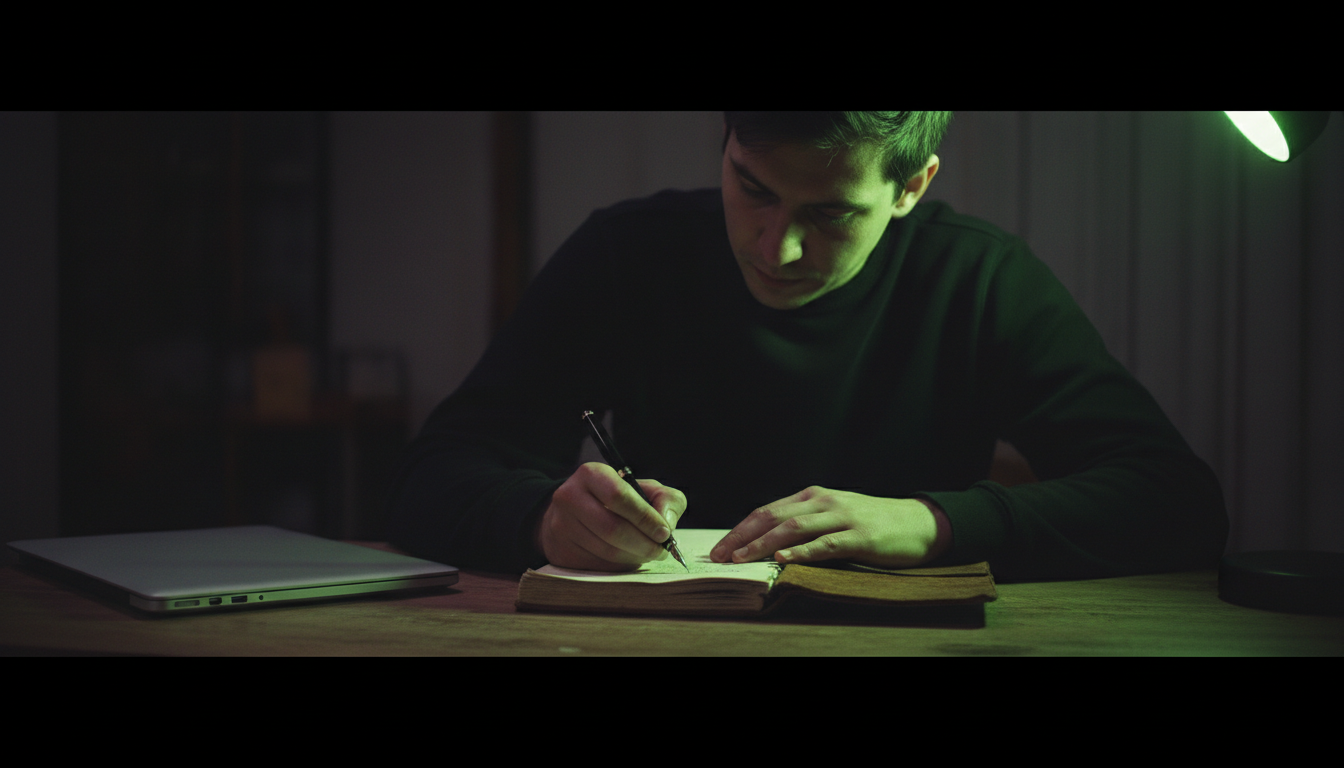
Nobody who bought a bad guide ever said "this sounds like a machine wrote it". They said it was thin. Obvious. Stuff they already knew. That's a different complaint, and it points somewhere most people never look. I spent a long time chasing better prompts to fix writing that felt flat, and the writing stayed flat. The problem was never happening at the writing stage. It was happening before I opened the tool, and once I saw where, I stopped rewriting drafts almost entirely.
This post is about the build step. You've already checked that people want the thing and you've got a rough price in your head. Now you have to actually make it, and the fear kicks in: what if it reads like every other file on the internet.
The scene: a blank page and a very fast tool
Here's where most people are when they start. The idea is validated. Someone has told them they'd pay for it. So they open a chat window and type something like "write me a 40-page guide on X for beginners".
And it works. That's the trap. Forty pages arrive in four minutes. It's structured, it's grammatical, it has an introduction and a conclusion and a section called "Common Mistakes to Avoid". You skim it and something in your gut goes quiet and cold, because it's fine. It's completely fine. And fine is unsellable.
So you do what everyone does. You go looking for a repair. You search for prompts that strip the robot out. You find threads full of people asking the same thing, on Reddit and everywhere else, all trading the same advice: be more specific, add a persona, tell it to write at a Year 9 reading level, ban the word "delve".
The low: I was editing the symptom
I did all of that. I built long, careful prompts. I gave the model a voice brief. I went through drafts deleting the tells one by one. The output got smoother, and it still landed the same way: correct, complete, and completely forgettable.
The honest version of what was happening: I was asking a tool to supply the one thing it cannot supply. Not personality. Not rhythm. Material. I hadn't given it anything of mine to work with, so it did the only thing it could, which was average out everything ever written on the topic and hand me the middle. The middle is where every generic product lives.
That's the real problem with a thin digital product. Not that a machine wrote it. That it could have been written by anyone, about anyone, for anyone. Buyers feel that instantly, even if they can't name it, which is exactly why so much of the chatter about digital products is people saying they paid for recycled air.
The shift: stop humanising the output, start loading the input
Here's the thing I do now, and it's the whole method. Before I write a single prompt, I sit down and extract the raw material out of my own head. On paper. Badly. It takes about forty minutes and it feels like homework, which is why nobody does it, which is why it works.
I answer six questions about the topic:
1. What did I get wrong first? The specific wrong turn I took. Not "I made mistakes" but the actual sequence: what I tried, why I believed it would work, what happened instead. This becomes the emotional spine of the product because it is the one thing a reader cannot get from a search.
2. What do I believe that most people teaching this disagree with? Write the sentence you'd have to defend in an argument. If your guide has no defensible opinion in it, it has no author. A model will never volunteer one, because its job is to reflect consensus.
3. What are my numbers? Real ones only. How long a thing actually took. What you actually charged. How many attempts it actually took to get right. If you don't have a number, say the qualitative truth instead and leave the number out. Never invent one. Invented numbers are the fastest way to lose a reader who checks.
4. What does the reader do on a Tuesday? Not the avatar. The scene. Where they are, what's on their screen, what time it is when they give up. Specificity of situation is what makes a reader think "this was written for me".
5. What's the one decision that changes the outcome? Every genuinely useful guide turns on a single decision the reader is currently making badly. Name it. That's your spine.
6. What did I have to throw away? The approach you abandoned, and why. Discarded work is enormously convincing, because nobody who hasn't done the work has anything to discard.
That's your input file. Messy notes, half sentences, nobody sees it.
Then, and only then, bring in the tool
Now AI does the job it's genuinely brilliant at, which is not invention. It's four things:
- Structure. Feed it the raw notes and ask it to propose three different ways to organise this material, with the logic for each. Pick one. Argue with the other two.
- Ordering. Ask what a reader needs to understand before section four makes sense. This is where it catches gaps you're blind to because you already know the thing.
- Drafting around your material. Section by section, not whole product at once. Give it your notes for that section and ask it to expand them, with a hard instruction: use nothing that isn't in these notes. If it needs something it doesn't have, tell it to leave a marked gap rather than fill it.
- Pressure-testing. Paste a finished section back and ask what a sceptical buyer would say is missing. Then go and answer that yourself.
The gaps matter more than the prose. When the model flags that it needs an example you haven't given it, that's a signal telling you exactly where your product is currently hollow. Go and fill it with something real. That single loop, draft, spot the gap, fill it from your own experience, is most of the work.
You'll notice you barely edit for tone any more. When the underlying material is specific to you, the voice mostly takes care of itself, because there's no consensus available for the model to fall back on.
One pass at the end, out loud
Read it aloud. Not for robot-detection, for friction. Anywhere you stumble or feel embarrassed, that's usually the sentence trying to sound authoritative instead of true. Cut it or rewrite it as the thing you'd actually say to a friend across a table. That's the only cosmetic step I keep, and it takes an hour on a full guide.
This is the same principle running through the whole Practical Income Method: the tool is fast, but you're the ingredient. Get that order wrong and speed just gets you to generic quicker.
This works for you, and it works faster than rewriting
You don't need to be a great writer for this. You don't need a big story or a dramatic result. You need forty minutes with a pen and the honesty to write down what you actually got wrong, what you actually think, and what you actually did. That's a barrier of effort, not of talent, which means it's fully in your control.
And it's genuinely quicker. Forty minutes of extraction up front beats a week of rewriting drafts that were never going to work, because you can't edit specificity into something that has none.
AI can't sound like you, because it has never been you. Give it something only you have, and the sounding takes care of itself.
Where to take this next
If you're at the build step, you're most of the way there already, but the build only pays off if the steps either side of it are right: a validated idea going in, and a way to sell it coming out. I've put the whole sequence into a free 5-step guide, the Practical Income Method, covering how to find an idea people will actually pay for, build it with AI without ending up in the generic middle, price it, and get the first sale without an audience. It's free, it's short, and you can start on step one tonight.
Tags
FREE SOLOPRENEUR PLAYBOOKS
Escape the 'Build & Pray' trap today.
Get the free 0-Dollar Distribution Checklist and the Eugene Schwartz ICP Discovery Matrix Google Sheets. 100% free, zero friction.
Explore Free Playbooks & Templates →