Oloye.
Content

How to Write an SOP for Posting Content Every Week

How to write an SOP for your content: the same simple steps every week, built from what you already know, so you post without starting from a blank page.

4 min read
How to Write an SOP for Posting Content Every Week

In short

  • Posting stops when every week starts from a blank page.
  • A content SOP is just your weekly posting steps, written down once.
  • Our own weekly routine, and the five lines we write for each step.
  • Start from what you already know, and the ideas stop running dry.

You sit down to post. You open the app, and nothing comes. You scroll for ideas, an hour goes, and you post nothing.

Next week, the same thing.

This guide shows how to write an SOP for your content, so each week starts from a page of steps, not a blank screen.

In plain words: SOP stands for standard operating procedure. It's the steps of a task written down in order, so it gets done the same way every time.

Why posting stops when every week starts from scratch

When there's no routine, every post asks you to decide everything again. What to talk about. Who it's for. How to start it. When to film it.

That's a lot of choices before you've made anything. So it gets pushed to tomorrow, and tomorrow fills up.

A written routine takes most of those choices away. You decide the steps once. After that, you just follow the page.

What a content SOP is

It's your weekly posting steps, written down. Nothing fancy. One page you open every time you sit down to make content.

We run our own content this way. Every step has a written page, from the week's plan to the numbers coming back. And every step we repeat gets written down. If there's no SOP, it isn't finished.

How to write an SOP for your content, step by step

Here's the shape of ours, made simple. Copy it, then change it to fit your week.
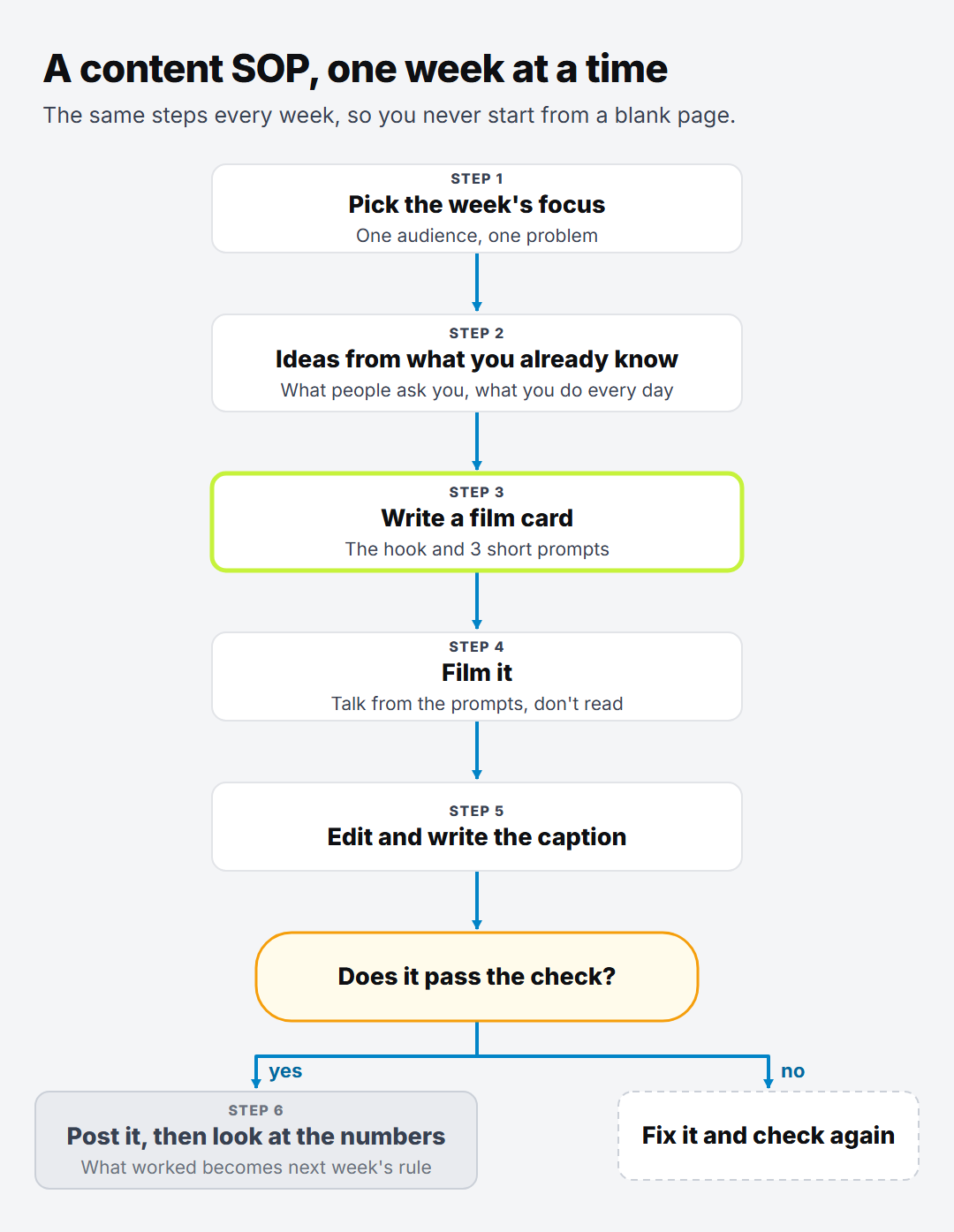
A flowchart of a weekly content SOP: pick the week's focus, get ideas from what you already know, write a film card, film it, edit and write the caption, check it, then post it and look at the numbers. If it fails the check, fix it and check again.

Step 1: Pick the week's focus

One line. Who is this week's content for, and what problem are you talking about? Write it at the top of the page.

Step 2: Get ideas from what you already know

This is where most people get stuck. They look at what everyone else is posting and try to copy it.

Start with you instead. What do people ask you? What do you do every day that others find hard? Those questions are your posts. We wrote more on this in what to post on TikTok when you have no ideas.

Step 3: Write a film card

For each idea, write a small card: the first line you'll say, and 3 short prompts to talk from. Not a full script. Prompts let you sound like yourself.

Step 4: Film it

Talk from the prompts. Don't read. If you lose your place, glance at the next prompt and keep going.

Step 5: Edit, caption and check

Cut it tight. Write the caption. Then check it against a short list before it goes out: is the first line about them, are the facts true, does it make sense with the sound off?

If it fails, fix it and check again.

Step 6: Post it, then look at the numbers

Once it's been out for a few days, look at which posts got saved and followed. Whatever worked becomes a rule for next week. That's how the SOP gets better each week.

Good to know: the check in step 5 is the one people skip. It's also what stops you posting something you'd delete an hour later.
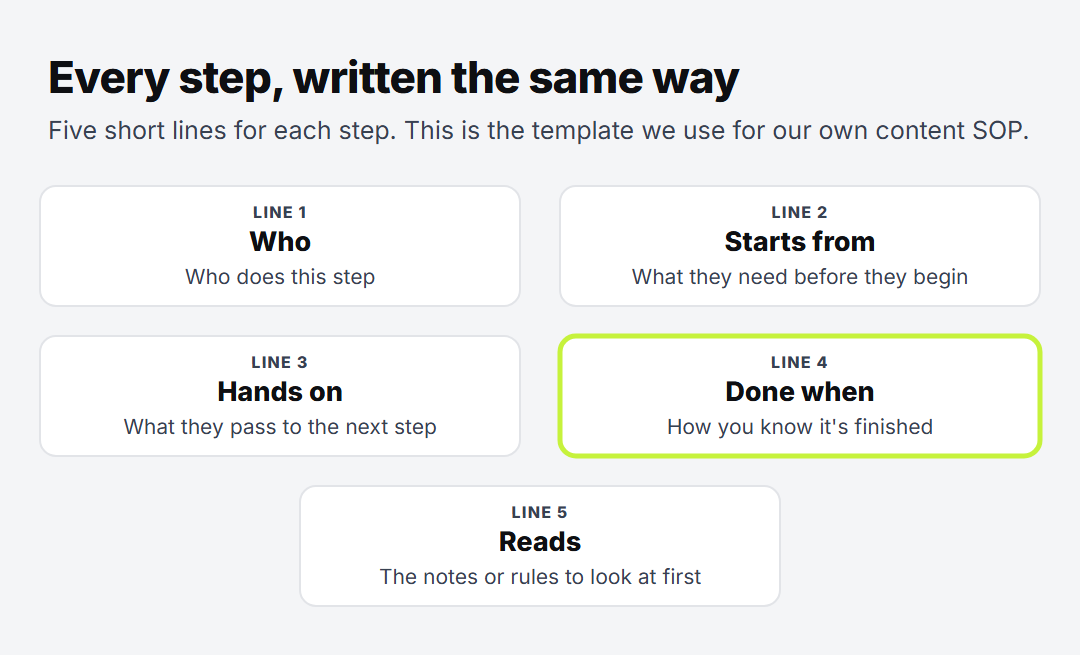
A simple SOP template for each step

Each step in our own content SOP is written the same way, in five short lines. Here's that template.

Five lines for each step of an SOP: who does it, what it starts from, what it hands on, how you know it's done, and what to read first

Line What to write
Who Who does this step. On your own, it's you, but write it anyway
Starts from What you need before you begin
Hands on What you pass to the next step
Done when How you know it's finished
Reads The notes or rules to look at first

"Done when" matters most. Without it, you keep fiddling with a post that was ready an hour ago.

Here's how step 3 could look, written out:

  • Who: you
  • Starts from: this week's focus line and your idea list
  • Hands on: one film card per post
  • Done when: each card has a first line and 3 prompts
  • Reads: your list of questions people ask you

Keep the SOP in one Google Doc you can open on your phone. If you'd like to record yourself doing a step, so you can see where you get stuck, Loom is a simple way to do it.

Try this: this week, write just steps 1 and 2 down. Next week, follow them before you open the app.

Use the same idea for other tasks

Once you know how to write an SOP for your content, the same idea works for any task you repeat. We use the same idea for our website forms. The steps for how each form lands in our list are written down, with a screenshot for each one. You can see the build in website forms to Airtable with Make.

Start with content, though. It's the task that most often stops because the page is blank.

Start with step 2 tonight

If step 2 is where you get stuck, try our free What to post page. Answer a few quick questions about what you know and what people ask you, and get ideas for posts, a free thing to give away and something to sell one day.

Then put the best ones on your page, and follow your steps.

Written by

Oloye Adeosun
Oloye Adeosun

Founder

Oloye builds AI systems for content creators and business owners, and has been building marketing systems for over 3 years. Creators get a content machine. Business owners, coaches included, get workflows that stop them losing leads. He lives in Kent with his family, and the point is the same for him as for you: more time for the work and the people that matter.

FAQ

Questions about this post

What is an SOP?

SOP stands for standard operating procedure. It's the steps of a task written down in order, so it gets done the same way every time.

What is a content SOP?

It's the steps you follow to make and post content each week, written down once. You follow the page instead of deciding everything again.

Do I need special software to write one?

No. A Google Doc is enough. Keep it short and keep it where you'll see it when you sit down to make content.

Where do the post ideas come from?

From what you already know: the questions people ask you and the things you do every day. That's step 2 of the SOP.

What task would you hand over first?

A free call. We'll find the first task worth automating, and you'll know the price before anything starts.